

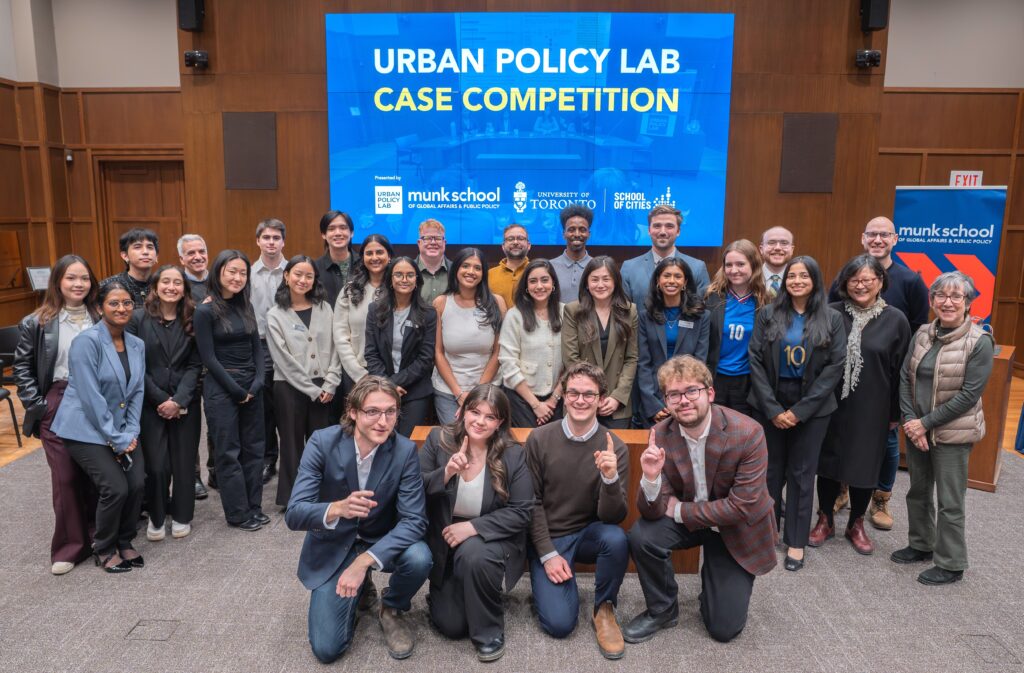
On January 16th, 53 graduate students from across the University of Toronto participated in the 2026 Urban Policy Lab Case Competition, hosted by the Munk School in partnership with the School of Cities.
This marked the ninth annual competition organized by the Lab and the first open to master’s students from across the university. In addition to students from the Munk School’s Master of Public Policy and Master of Global Affairs programs, participants came from the Master of Urban Innovation, Master of Science in Planning, and Master of Information programs.
This year’s competition focused on the legacy of FIFA World Cup 26. Over two weeks, students developed creative and innovative proposals to leverage the tournament for lasting positive impact in Toronto, including ideas related to transit, arts and culture, and youth employment.
Teams were paired with Munk School alumni mentors, who helped refine proposals and provided critical feedback throughout the process:
-
- Lamia Agnagic: Senior Strategic Policy Consultant, Housing Secretariat, City of Toronto
- Renae Appadurai: Analyst, Treasury Board Secretariat, Government of Canada
- Christian Avendano: Policy and Strategic Planning Consultant, Exhibition Place
- Mike Love: Senior Policy Advisor, Sports Policy Unit, Ontario Ministry of Tourism, Culture and Sport
- Kimberly Nesbeth: Anti-Racism Policy Consultant, Toronto Transit Commission
- Diana Tsui: Strategy & Governance Analyst, Toronto Police Services Board
- Nirmalan Vijeyakumar: Senior Project Manager, Transportation Services, City of Toronto
On competition day, students presented their ideas to panels of expert judges, including:
- Ilana Altman, Co-Executive Director of the Bentway, and Urbanist-in-Residence, School of Cities
- Alexander Bordokas, Economic Development Officer, City of Toronto
- Simon Darnell, Associate Professor and Director, U of T Centre for Sport Policy Studies
- Ige Egal, Founder and CEO, Play for Dignity
- Josh Fullan, Executive Director, Maximum City
- Sally Han, Executive Officer, School of Arts, Media, Performance and Design, York University
- Ben Macintosh, Manager of Cultural Partnerships, City of Toronto
- Tobias Novogrodsky, Deputy City Clerk, City of Toronto
- David Roberts, Associate Professor, Geography and Planning, U of T
- Enid Slack, Director, Institute on Municipal Finance and Governance, School of Cities
 Winners of the 2026 Urban Policy Lab Case Competition — Olivia Daley, Liam Coady, Jordan Simons, and Keevyn Hirschfield.
Congratulations to the winning team, made up of first-year Master of Public Policy students Liam Coady, Olivia Daley, Keevyn Hirschfield, and Jordan Simons! Their team identified a mobility crisis in Toronto, marked by congestion, inequitable transit access, and long commute times that threaten both a positive World Cup legacy and long-term municipal priorities. They identified the World Cup as a once-in-a-generation opportunity to work with stakeholders to advance expanded RapidTO lanes and Transit Signal Priority, leveraging the significant economic activity and traffic associated with event. After winning the competition, Jordan went on to present his team’s case to the City of Toronto’s World Cup 2026 Subcommittee!
 Judges Tobias Novogrodsky and Ilana Altman at the 2026 Urban Policy Lab Case Competition
Two teams were selected as runners-up. First-year MPP students Ritika Roy Chowdhury, Phoenix Seelochan, Mehek Berry, and Liam Barry proposed a “hat-trick” of policy recommendations under their Kickstarting Communities Plan. The proposal included the creation of cultural community watch zones across Toronto, a school-anchored access pass to ensure equitable youth participation in recreation, and a youth human rights ambassador program to equip young people from marginalized communities with civic skills and leadership opportunities. Another team of first-year MPP students, Anton Trygub, Maya Balamurugan, Shareen Fabiola, and Ira Trocme, focused on improving transit efficiency, increasing employment accessibility and providing skills and experience to historically marginalized youth groups, and extending cultural and economic impact of the World Cup through Community Art.
Other groups presented the following:
- Naomi Papavero, Marlo Scharf, Diane Gorun, and Watipa Chitondo proposed a local economic diffusion credit program, through a citywide pass mobile app that would encourage World Cup ticket holders and tourists in Toronto to explore the city and support local businesses through special discounts.
- Gary Wang, Nour Sbeih, Alexia Cernat, and Lewei Gao proposed a community, sport, and equity monitoring dashboard to monitor the success of the “Soccer for All Legacy Program” during and following the World Cup.
- Valentina De Leon, Rita Maragha, Moaiad Saif, and Maham Ali proposed supports for local and equity-deserving artists for World Cup cultural programming and art installations, attracting economic activity to small businesses through a targeted marketing campaign (FIFALICIOUS), and establishing specific human rights protections for vulnerable community members.
- Gabby Fang, Pratykka Kugarajh, Celdric Payomo, and Sarah Hyeon-A Kim proposed a human rights framework developed through stakeholder engagement for the World Cup, and implemented in the long-term to be used for future major events taking place in Toronto.
 Anton Trygub, Maya Balamurugan, Shareen Fabiola, and Ira Trocme presenting to judges David Roberts, Ige Egal, Sally Han, and Alexander Bordokas at the 2026 Urban Policy Lab Case Competition.
- Devam Sheth, Aarij Khan, Seongcheol Im, and Anvita Dattatreya proposed a support framework for people experiencing homelessness during the World Cup to prevent displacement, protect human rights, and create permanent social infrastructure that aligns with Toronto’s long term housing and equity priorities.
- Effie Lin, Jeanne St-Pierre, Claire Sarson, and Kiran Singh proposed a Standing Table on mega-events, convened and chaired by the City of Toronto, with a mandate to advise city council on program adaptation, scaling, and sunsetting, oversee transition of legacy programs into permanent City divisions and partner organisations, translate community feedback to post-event best practice, and monitoring of programs.
- Hermela Samuel, Jackie Tarka, Hannah Yamoah, and Ayyan Tareen proposed a plan that involved connecting with ethnic groups for community engagement and collaboration, strategic targeting of BIAs through a vendor permitting and licensing strategy, and utilization of precedents and current context to forecast and mitigate human rights and equity risks.
- Olivia Ou, Kate Blackman, Mariusz Buczkowski, and Anthony Bojkovski proposed strengthening soccer coaches’ capacity to address mental health challenges among youth through inclusive leadership and culturally responsive training, with clear referral pathways to community services.
- Regan Simpson, Stephanie Fadel, Andrea Villa, and Ash More proposed a two-track legacy strategy that anchors community third spaces through sports, culture, and youth-centred programming, while embedding workforce and skills pathways for groups historically excluded from sport governance and officiating roles.
- Maheen Hasnat and Aisha Assan-Lebbe proposed the installation of photovoltaic panels at BMO field to generate renewable energy during and beyond the World Cup, for future major events and long term municipal use.
- Avishka Gautham, Omar Hassan, and Olivia Band proposed the ‘NextGoal Youth Program’, which created future-focused and skills-rich roles for marginalized youth in Toronto by utilizing resources wasted after the World Cup.
Thank you to the judges, mentors and all our student participants for bringing together a successful and exciting event!
