

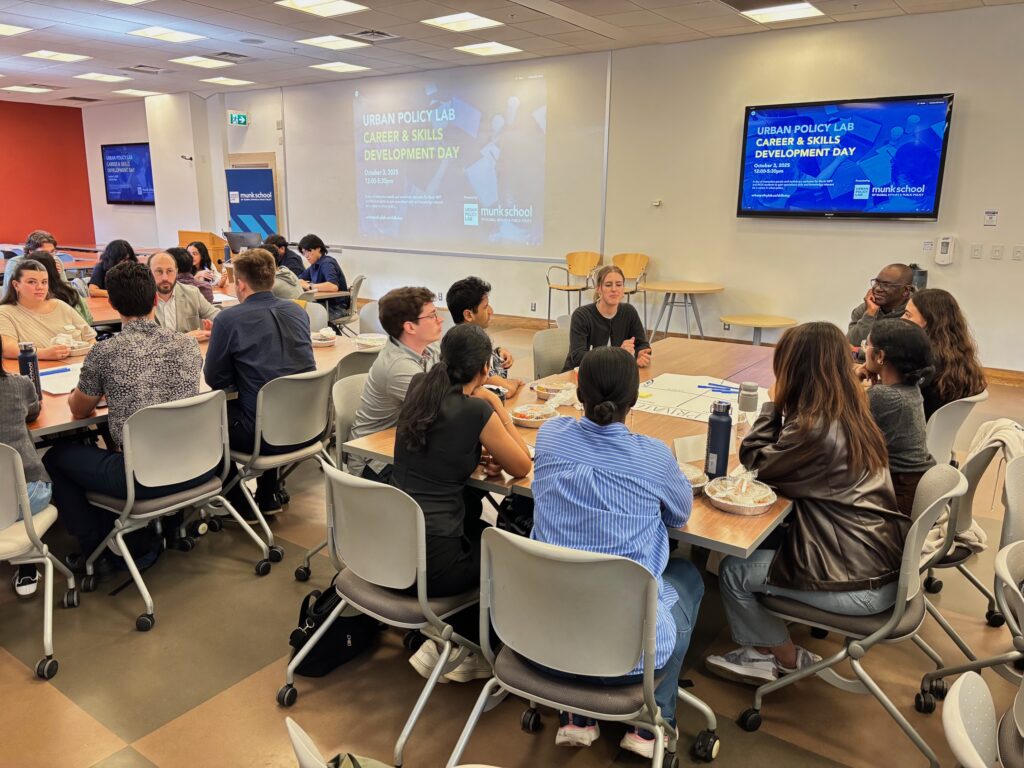
The Urban Policy Lab’s Career and Skills Development Day returned on Oct 3, 2025, to help prepare future urban policy leaders for meaningful careers in the field.
Nearly 80 Master of Public Policy and Master of Global Affairs students joined a full afternoon of workshops focused on building practical skills and professional insight for careers in urban policy across sectors and levels of government.
The event offered students a chance to engage with practitioners, explore different areas of city building, and deepen their understanding of how urban policy is shaped and implemented.
UPL Fellow Ananya Yadav shares her recap of the highlights.
Exploring Career Pathways in Urban Policy

The afternoon began with a session for first-year students titled Careers in Urban Policy, facilitated by Munk alumni:
- Andrew Blackburn, Government Relations Advisor, Good Roads Association
- Sara Szot, Senior Consultant, StrategyCorp
- Diana Tsui, Analyst, Toronto Police Services Board
- Omar Ali, Policy Analyst, Natural Resources Canada
- Vienna Vendittelli, Senior Advisor, Metrolinx

Students rotated between tables organized by sector — municipal, provincial, and federal governments, the private sector, and non-profit — and alumni guided small-group discussions about what a career in urban policy looks like in their area of work.
The session helped first-year students explore potential career paths in urban policy and sparked excitement about the opportunities ahead.
Facilitators discussed the kinds of policy issues professionals encounter in their sector, the projects and programs they might work on, strategies for finding and landing jobs, and the key skills needed to succeed after completing the MPP or MGA programs.
Understanding the Fundamentals of Municipal Finance
While first-year students explored where their degrees might take them, second-year students turned their attention to one of the most complex aspects of city governance: how municipalities manage their money.
In Making Sense of Municipal Finance, MPP alum Lauren Birch, Director of Financial Strategy and Policy at the City of Toronto, guided students through the City’s finance functions including revenue services, financial strategy and policy, and purchasing and materials management, as well as differences between operating and capital budgets.

The session included many memorable moments, including a scavenger hunt through Toronto’s budget documents, to practice reading and understanding complex financial reports, and a discussion of “Swiftonomics,” using Taylor Swift’s Toronto concert as a case study to illustrate how large cultural events impact local economies and municipal budgets.
Toronto Behind The Scenes
The day’s next two concurrent sessions focused on city building both inside and outside government.
In City Council 101: Politics vs. Process, Wyndham Bettencourt-McCarthy, Chief of Staff to Toronto City Councillor Alejandra Bravo, led students through an interactive exploration of how decisions are made at City Hall.

Students examined who builds the city, who benefits from policy decisions, and how political and administrative processes intersect. They learned about the roles of committees, community councils, and the media, using examples like snow clearing and ride-sharing to illustrate the tensions between policy intent and political realities.
At the same time, another session took a different perspective, asking what it means to build cities through community, creativity, and civic engagement. Lanrick Bennett Jr., Manager of Donor Education and Engagement at United Way Greater Toronto led The Civic Prescription: A City Builder’s Story.
Drawing from his experience in mobility, placemaking, and community engagement — including serving as Toronto’s first “Bicycle Mayor” — Lanrick shared how city-building begins in everyday spaces and actions.

He spoke about how cities shape the way people move, connect, and care for one another, and how his own experience as a parent and advocate have informed his approach to civic work. Through reflection and discussion, the session encouraged students to see how policy plays out in everyday life and to consider how empathy, inclusion, and creativity shape better cities.
Building Better Engagement from the Inside Out
The day concluded with a highly interactive simulation designed by Daniel Fusca, Manager of Public Consultation, and Lauren Grosberg, MPP alum and Coordinator for Outreach and Special Projects in the City of Toronto’s Parks, Forestry, and Recreation division.


In Bringing City Leadership Together: Internal Consultation and Public Engagement, students took on different professional roles within various municipal departments during the development of a new City initiative.
Students participated in two rounds of simulations: a “messy meeting” and a “facilitated session.” The contrast helped participants recognize how strong facilitation and principled objectives can foster internal consensus and lead to better policy outcomes.
The activity showed how clear communication, collaboration, and thoughtful process design help teams reach alignment in complex public sector settings.
Together, these learning experiences showcased the Urban Policy Lab’s role in connecting classroom learning with real-world practice, giving students a chance to apply their skills, gain confidence, and engage directly with leaders shaping urban policy today.